#24 Themis

Smaller Graph
|
"#24 Themis" is the official designation of a minor planet, also known as an asteroid. Anyone with WWW access
can begin to access and confirm the data for Themis at
NASA's Jet Propulsion Laboratory "Horizon's" site. Complete step-by-step instructions for how to generate data for the asteroid #24 Themis can be found here: Using NASA's JPL Solar System Dynamics site A Web program to visually display the orbit can be found here: NASA's Jet Propulsion Laboratory Orbits program. Just type "24 themis" into the edit box, and press the Enter key. The bright yellow horizontal line in the "Orbits" program points at 0° (also, see the graphic below), with the less prominent continuation of that same line pointing at 180°. Note that this "Orbits" Web application displays a basic heliocentric (Sun-centered) configuration of our Solar System, while the graphs used in this project are displaying geocentric data. Both heliocentric and geocentric use the same 0° point as an essential frame of reference. Heliocentric positions are more often used as the basis for performing the initial calculations, and then more often transformed, using the actual Earth's position, then resulting in a geocentric position. This presentation is being initially released in the Fall of 2002. If you can visually draw a line from the Earth through the Sun at the red dot, you can begin to see that the Sun has now 'moved' past the autumnal equinox, and as the Earth continues in its orbit, the geocentric relationship can be observed moving towards the bright yellow line, which is 0° and the vernal equinox, or Spring. The "Orbits" program will allow you to click and advance the positions, giving you an opportunity to observe the process. Using this "Orbits" program, visualize a line from Earth to 24 Themis, and you have the basic geocentric configuration. |
|
Each graph represents 20 years of data, progressing left to right, with each year, month, quarter, and half-year
indicated underneath the numeric year and repeated at the bottom of the graph. A modulus of 2 is used: any value greater than 180° has that amount in excess of 180° subtracted. So, 179° and 181° represent the same vertical value on the graph, allowing us to explicitly observe when the process begins anew at 0° and when it reaches the point opposite the equinox at 180°. |
|
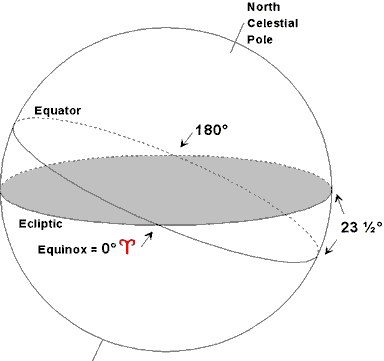
0° is equal to the Aries point, or the equinox, and is a fundamental reference point in Earth-based, or geocentric, astronomy. The equinox represents the point of intersection of the mean plane of the equator and the ecliptic. The ecliptic is the mean plane of the Earth's orbit around the Sun. 0° is also referred to as the vernal equinox, while the point opposite, at 180°, can be referred to as the autumnal equinox. These points and planes define the essential references we use in our astronomy. The diagram on the right represents the celestial sphere, oriented from the Earth, and can be viewed as extending infinitely in all directions. When another body has a geocentric position of 0° or 180°, that means that the body under observation appears at that position (0°, 180° or any other degree) as it is viewed from Earth. When that body in question 'transits' the 0° or 180° point as emphasized in this material, that body is transiting the axis of the equinoxes. Measured against this axis, the transits of #24 Themis are coinciding with all of our major wars in this century and our most significant events of cultural dominance and conflict. |
|
|
"Themis" is the Greek name, from the pre-classical era, of the Titan Goddess responsible
for convening the Gods and Goddesses at Olympus. Though our culture has come to believe that
Zeus was the most powerful, even Zeus had to abide by the authority designated to Themis. The most sacred site of the Greeks, Delphi, was believed by the early Greeks to have been actually presided over by Themis, until the advent of Apollo. It has been suggested that Themis is Gaia (Earth) herself, evolved into the personification of Justice. It is Themis who we see depicted blindfolded, holding the sword and the scales. Her name has been almost lost to common memory, yet we would do well to foster a rebirth of consciousness in her regard. As society evolved, so did the mythology of the Greeks. Themis gave birth to a new Goddess of Justice, Diké, representing new needs and ideas. |
|
This material may take some time to assimilate. Many of us have been fostered by cultures which will inherently
resist investing any credence in this material. This material raises many more questions than it provides answers for.
Yet, it cannot be denied that there is at least an apparent correlation between the data and many of our gravest historical events.
Perhaps, for now, the significance of this material is simply that we each may need to more fully examine our real needs, choices,
and responsibilities. Perhaps we are simply being asked to contemplate our relationship to the world around us,
and try to find better questions, rather than grasping at the easy answers that some seem to offer. We do not always have to fully understand a phenomena in order to take advantage of the opportunities it may present. Our most advanced technologies employ this approach every day, though, granted, not always with the most responsible foresight. Yet, today, the world may be on the brink of another man-made cataclysm, for which we have no means to foresee the real outcome and consequences. The world's only superpower, which lays claim to being the greatest democracy, and often appears to value free speech among the most cherished of rights, cannot sustain a reasonable dialogue above the noise of its leader's war drum. The vast majority of elected representatives for this alleged greatest democracy have been silenced for fear that they may make a 'mistake' in favor of reason, so they appear to choose in favor of their job security, rather than their elected responsibility. |
|
The Graphs and Events page contains
a number of references to events that do not appear to be about war. Many
phenomena of societal behavior, or individual behavior, are symptoms of a
more fundamental issue or need. War is an extreme manifestation of a normal and continuing process of a culture maintaining itself. Human cultures or societies have developed essential systems for their survival. An economy, a system of beliefs establishing a relationship with the larger reality, and a set of norms to be adhered to and maintained are the basic components of human societies. The process portrayed in the graphs appears to tie all our major wars together. So we might then begin to ask is there a relationship between these other 'non-war' events and war itself? It is relatively simple to make the association of "10/6/1908 Austria annexes Bosnia and Herzegovina" to World War I. There is then not much difference between that event of asserting and extending cultural dominance, and an act of resisting the continuation of cultural dominance exemplified by "11/9/1969 Indians of All Tribes occupy Alcatraz Island" and "2/27/1973 The American Indian Movement (AIM) begins an occupation at the site of the 1890 Wounded Knee massacre." The event "4/21/1967 Greece has a right-wing coup and begins a 7-year military dictatorship" can be seen as having a graph relationship to "8/17/1964 Greece withdraws its military units from NATO." The latter event is about Greece's relationship to the mega-culture or society of Europe, while the former can be seen as an attempt to maintain cultural dominance of those within, just as "5/20/1989 China declares martial law in response to a pro-democracy demonstration in Beijing's Tiananmen Square." The graph depicts the data as a process. The 'hits' at 0° and 180° are then simply applied to the 'database' of noted historical events. Some editing has been applied to elicit and simplify the point being made. All graphs are selected depictions of data. That is the point of using graphs. They are a tool to help us perceive patterns within what is often enormous amounts of data. So the point of including these apparently non-war-related events is to suggest that we might think about war within a larger context. Then we can expand our ability to evolve as a society by better addressing the larger underlying issues about what and how a culture truly needs to maintain itself. Then we might reevaluate where we need to draw the lines in acceptable behavior before we risk becoming a society not worth maintaining. |