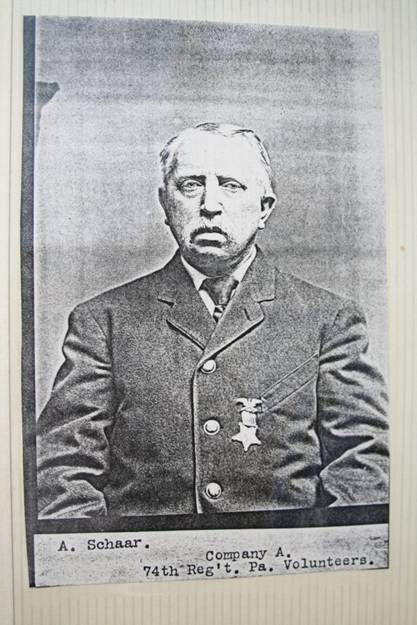
Drummer Alois Schaar
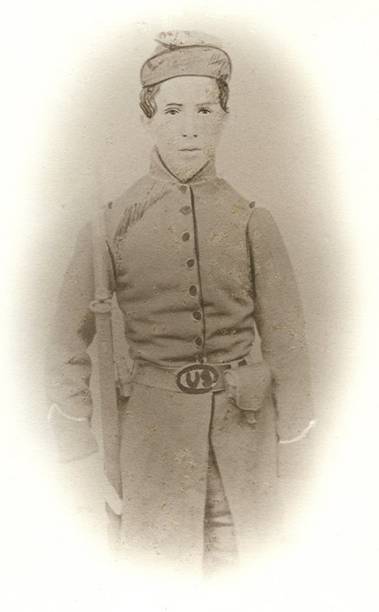 Was born in July 1846, but he claimed to be born in 1843 according to the
regimental descriptive books, in the village of Bad Reinerz (Polish:
Duszniki Zdroj), Glatz County (Polish: Klodzko), Breslau
Administrative District, Province of Silesia, Kingdom of Prussia. He emigrated to the United States in 1857 and became a naturalized U.S.
citizen. After the war, he was lived at 843 Frederick Avenue, Baltimore, Maryland.
Was born in July 1846, but he claimed to be born in 1843 according to the
regimental descriptive books, in the village of Bad Reinerz (Polish:
Duszniki Zdroj), Glatz County (Polish: Klodzko), Breslau
Administrative District, Province of Silesia, Kingdom of Prussia. He emigrated to the United States in 1857 and became a naturalized U.S.
citizen. After the war, he was lived at 843 Frederick Avenue, Baltimore, Maryland.
In
1861 Private Schaar stood 5'0.5", had a healthy complexion, blue eyes and
light brown hair. He stated that in
1861 he was employed as a gardener, in 1880 and 1910 as a harness maker.
He was recruited on 17 June 1861 by Adolph von Hartung, and mustered in 5 August 1861 for three years as
a Private (drummer) at Camp Egglesfield, Philadelphia,
by Captain Joseph Hunter McArthur, 2nd U.S. Cavalry. He was wounded in action 22 August 1862 at
Freeman's Ford. But after recovering
from his wounds, he returned to the regiment and was mustered out 16 September
1864 with expiration of term of service at Fort Ethan Allen, Virginia. Private Schaar saw action at Cross Keys,
Freeman's Ford, Chancellorsville, and Gettysburg.
After the war, he married
Catherine (Katie, b. September 1854) c. 1870 in Baltimore, Maryland
. They had the following
children:
·
Melissa C. (b. ca.
1874),
·
Julia E. (b. January
1882),
·
Matilda (b. June 1888),
·
Walter
A. (b. September 1890),
·
Frederick (b. June 1892),
·
Wilhelmina
R. ("Minnie", b. September 1894), and
·
Emma ("Emmy",
b. September 1896).
The
family recalls a story about how Private Schaar met President Abraham
Lincoln.
Alois
walked with a cane in old age, presumably due to the injuries he sustained at
Freeman’s Ford. He was successful in
business owning his own shop on Frederick
Avenue in Baltimore
where he worked as a harnassmaker. His
family remembers how he “religiously went to Loudon
Park Cemetery
in Baltimore
with is children and put flower petals on the graves of Civil War
Veterans. At Christmas, he would make
his children sing patriotic songs when the special family ornament was put on
the tree.” That ornament remains in the
family’s possession today. On the 4th
of July, Alois would take his entire family to Gettysburg for a picnic next to the monument.
His
daughter, my grandmother, lived a long life and died in her ninety's. She
shared many stories of her father with me that I recorded. One story she told
me involves Abe Lincoln. The story goes like this: After he was
hospitalized in a Washington
hospital and recovering from his wounds ( wounds he received at Freeman's
Ford - shot three times, in the back of neck and behind each knee),
Abe Lincoln visited the hospital and shook his hand. Instead of getting
discharged, he was released from the hospital after recovering from his
wounds just in time to re-join his regiment just before the Battle of
Chancellorsville.
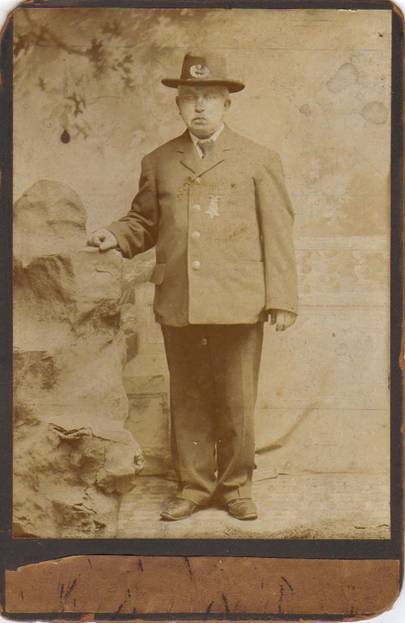
Alois
also attend the G.A.R. parade in 1925 that took place in Washington D.C. The image on the bottom right is from that
parade courtesy of another descendant of Alois who shared it with Champ.
There are a few other
items associated with Alois Schaar here on the website:
1888Dedication.htm
CompanyA.htm
74thMedal.htm
Champ Zumbrun