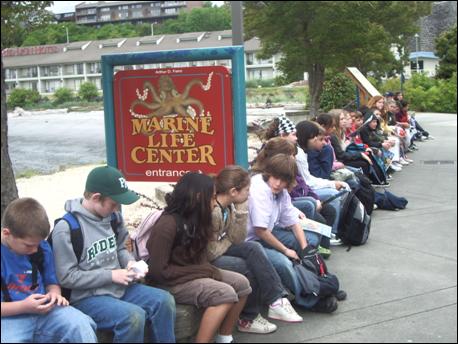
Feiro Marine Life Center
Strategic Plan
2008-2013
"…the go-to place on the north Olympic Peninsula for marine education. Feiro Marine Life Center helps people see beneath the surface and become stewards of our shared marine environment."
Feiro Marine Life Center Board of Director’s Vision Statement, June 2008
Table of Contents
Page Number
Cover page 1
Background 2
Similar Organizations 3
The Opportunity 4
Overall Strategy 5
Analysis of Existing Situation 5
Strengths 5
Weaknesses 6
Opportunities 7
Threats 9
Goals and Objectives 10-12
Background
The Feiro Marine Life Center (FMLC), an educational and scientific organization promoting marine education and conservation, is a 501(c) (3) nonprofit corporation that is centrally located on the waterfront of Port Angeles, Washington. Port Angeles, situated on the Strait of Juan de Fuca at the foot of the Olympic Mountains, is the county seat for Clallam County, the business and financial center for the North Olympic
Peninsula, a gateway for visitors entering the country by ferry from Victoria, British Columbia, Canada and the major entrance to Olympic National Park.
The FMLC is fondly known in the community as "the jewel of the waterfront." It hosts public exhibits representative of the marine life inhabiting the Strait of Juan de Fuca. It provides classroom space for marine science related programs, and has a small library, specimen collection and laboratory for academic studies. The FMLC has sponsored community presentations by a number of world-renowned experts. Additional community educational programs for students of all ages are scheduled on a regular basis. The FMLC is open on weekends during the winter months and six days per week during the busy summer season. Over 10,000 visitors and students visit the center each year.
The FMLC facility was established in 1981 by the late Arthur D. Feiro. Art was a high school science teacher who recognized the value of a place on the Port Angeles waterfront to introduce children and residents of the Port Angeles community to the marine environment he so loved. He also recognized the educational value of this small aquarium to visitors who pass through the city by the thousands each summer. Art and his cadre of volunteers conducted numerous community fundraisers, built lasting partnerships in the community, and created the FMLC to teach all those who pass through its doors the wonders of the ocean. Art envisioned the FMLC as "…. (a) multifaceted, dynamic, living, breathing facility …. (providing a) public display of marine organisms and ecosystems, a teaching laboratory, a public center for marine studies and a point of interest for tourists." Since it opened its doors in 1981 the FMLC has successfully met these objectives.
SIMILAR ORGANIZATIONS
The Olympic Peninsula is host to a number of small marine science education facilities. Each has its own unique focus and provides marine science education programming to residents and visitors. The success of these facilities is attributed to funding support through their nonprofit status, and to their ability to provide quality education programs to the public schools and the community at large.
These facilities include:
Port Townsend Marine Science Center (PTMSC) was established the same year as the Feiro Marine Life Center, but was established at its inception as a nonprofit organization. The PTMSC offers exemplary programming to the community and to visitors, including school education programs, summer camps and special interest speakers. Eighty percent of PTSMC’s operating costs are derived from program fees. They have also successfully secured funds from several larger foundations, and are partners with the Burke Museum.
Poulsbo Marine Science Center (PMSC) has a history similar to
that of the FMLC. It was initially managed and financially supported
by the City of Poulsbo. The school district also supported the
facility and covered the cost of all public school education
programs.
Both of these entities were unable to support the PMSC and the
facility closed its doors for two years while developing their
nonprofit status and engaging in successful fundraising efforts. The
PMSC has received significant state funding, NOAA funding and
funding from the Blank Foundation. They have been able to update the
facility and hired new staff.
THE OPPORTUNITY
Over the years, FMLC has been admirably supported by the City of Port Angeles (City) and Peninsula College (College). Both the City and College now face increasing demands on their limited funding, bringing their continued funding of the FMLC into question and the FMLC to a pivotal point in its history.
To address this issue, a steering committee, the Marine Science Initiative, was appointed in March, 2007. This committee was led by College staff and consisted of engaged individuals, local citizen groups and government agencies. It discussed and made recommendations for the future of the FMLC. This committee recommended that the FMLC become a nonprofit, independent, entity supervised by a board of directors. Its mission would be "to foster the understanding of and a commitment to the health of the marine environment and related watersheds of the Olympic Peninsula, and their importance to its communities."
For a limited time, the FMLC continues to be supported, both fiscally and administratively, by the City and College. The City retains ownership of the facility and is contributing $45,000 for staffing in 2008 The College contributes $15,000 annually to supplement the staffing costs and provides administrative services for the staff. The current funding level supports one 3/4 –time staff position and one 1/4 –time staff position as well as three seasonal positions during the summer visitor season from mid-May through mid-September. The City and the College have signed an inter-local agreement of support for the FMLC for 2008. Recently, the board of directors hired an administrator/educational director whose salary will reflect on going fund raising efforts.
Very clearly, the FLMC is in transition. The most urgent need is to smoothly move toward establishing a self-sufficient, non-profit entity, under the direction of the recently appointed board of directors, to secure sufficient funding to continue existing programs, and to develop a realistic approach to expand Art Feiro’s vision for the future.
This strategic plan is intended to guide this transition and the FMLC’s work for the next three to five years. It will include specific goals to upgrade facilities, enhance educational outreach, explore research partnership opportunities, and grow into a more vital and visible destination for resident and non-resident visitors.
The purpose of this plan is twofold. First, a document is needed that clarifies a vision and sets future goals for the FLMC and provides a detailed blueprint to guide the board of directors and staff as they move forward to implement the vision and goals. Second, an executive summary of the plan will be produced for use in seeking grants and other sources of funding while presenting a vision of the future to a broader audience. It is anticipated that this strategic plan will be a ‘living’ document in that it will need periodic review over a period of 3-5 years, at which time a new strategic plan may be appropriate.
For the purposes of this plan, the word community will be used in describing the population of the North Olympic Peninsula.
OUR STRATEGY
Six strategic goals have been identified in this document together with a number of objectives offering specific targets for each goal. Each of these goals is important, and will be aggressively pursued during the life of this plan.
However, given the immediate needs of becoming a functional, independent, non-profit organization, for the immediate future the principle strategy will be twofold: to stabilize and strengthen the institutional capacity of the FMLC, and to incrementally build on the success of the existing programs.
ANALYSIS OF EXISITING SITUATION
STRENGTHS
Administrative Infrastructure
Non-profit status in place offering flexibility in seeking funding sources
Active component of the local community
Community support from diverse groups and individuals
Enthusiastic and versatile board of directors well connected with a wide cross section of the community
Legal, fiscal, research and education expertise among board members
Fiscal
501(c) (3) status established
Grant application process ongoing
Physical Plant
Innovative water system for aquarium exhibits allowing water to be pumped directly from the harbor, through the exhibits and back into the harbor
Prime location on the Port Angeles waterfront
Interactive exhibits including touch tanks and aquaria
Office Area
Flexible classroom area
Audio-visual equipment including laptop computer, projector, and large TV with DVD and VHS capabilities
Teaching laboratory with 10 compound microscopes and 12 dissecting scopes
Small laboratory area available for research
Staff
Dedicated staff with diverse capabilities committed to making the FMLC successful
AmeriCorps and interns available as a talented and inexpensive addition to staff
Volunteers
Strong group of dedicated, versatile and well educated volunteers
Growing retirement communities on the North Olympic Peninsula provide potential volunteer source
Education Outreach
Established outreach program for elementary schools that served over 600 students in 2007
Partnership with other education facilities (Seattle Aquarium, Olympic Coast National Marine Sanctuary, Port Angeles School District, Olympic Park Institute) for curriculum and staff support
Research and Partnerships
Variety of marine and terrestrial ecosystems are located nearby
Long standing association with Battelle (an international science and technology corporation with a lab and offices located in Sequim), Peninsula College and Olympic Coast National Marine Sanctuary
Strong board and community support for additional partnering efforts
Support of citizen science organizations such as Streamkeepers
Visitation
Over 27 years of visitor and public service; FMLC now hosts an average of 10,000 visitors and up to 1,000 students each year
Daily Port Angeles-Victoria ferries bring visitors to the waterfront
Port Angeles is a primary gateway to the Olympic Peninsula and Olympic National Park
WEAKNESSES
Administrative Infrastructure
Transition from City and College management to non-profit management interim period is the initial challenge
Fiscal
Current sources of income (City and College) to be at least partially removed in 2009
Small and uncertain base of recurrent funding
Lack of diversity of funding sources
Physical Plant
Monitoring and emergency notification system needed to detect water system failure
Facility has changed little over the past 27 years; needs updated appearance, state of the art displays, signage, etc. to make display area more aesthetically pleasing
Office Area
Much of the office equipment is nearing end of useful life, making administrative tasks difficult and time-consuming
Volunteers
More volunteers needed to effectively operate the FMLC as a public education facility
Staff
Additional staffing needed to effectively operate and meet organization goals
Education Outreach
Middle and high school students underserved by current program
Current staffing levels make it impossible for FMLC to participate in science education committees
Research
FMLC does not have a track record as research facility
Current space and facilities inadequate for a well-developed research program.
Visitation
Poor visibility to attract visitors
Displays are outdated
Insufficient promotional material
Administrative Infrastructure
New nonprofit board is diverse and representative of a number of key stakeholders in the community.
New board and expanded staff offer strong potential to set new direction for the future of the FMLC
Fiscal
Increased opportunities and latitude for funding through grants, community foundations, capital campaigns, planned giving, etc.
Physical Plant
Upgrading facilities offers opportunities to set an example in green technology, renewable energy, etc. in a very visible location
Upgraded center will encourage visitation with potential to become a corner stone attraction for visitors and residents.
Potential for FMLC to be center for all marine related information
Office Area
Potential for private businesses and organizations to donate labor to install updated equipment and renovate work space
Volunteers
Growing pool of retired professionals in community from which to recruit volunteers
Staff
With minimal staffing at present, we have the opportunity to identify priority needs and staffing as identified in this strategic plan
Education Outreach
With increased focus on ocean health, the FMLC is in a prime position to provide marine science education to all ages of students
FMLC is in an excellent position to interpret environmental projects in the community, including removal of two dams on the Elwha River, Tsewhitzen, Rayonier Superfund Site, Puget Sound Partnership, etc.
Expansion of existing website to strengthen educational and outreach elements
Research
The new board structure and potential growth provides an opportunity to work more closely with NOAA, Battelle, and Peninsula College to upgrade FMCL involvement in professional, student and citizen science research.
Visitation
Provide updated displays of ocean life
Well-placed information and marketing efforts can result in increased visibility and awareness of the FMLC, making it another key destination for visitors to the North Olympic Peninsula
Opportunity to provide interesting and relevant information about a the health of the oceans and how each of us play a part in the future of the oceans
THREATS
Administrative Infrastructure
The restructuring process will require substantial time and effort from the new board of directors and existing staff
Fiscal
Limited staff to apply for grants or other funding sources
Grants are highly competitive and not a guarantee of future funding
Very limited recurrent funding opportunities
Physical Plant
City and College lack resources to support changes in building appearance or floor layout
Potential for contamination by combined sewage overflow events from nearby Peabody Creek
Office Area
City and College lack resources to support upgrade of computers, internet capabilities and office equipment
Volunteers
Difficult to maintain scheduling because of retired groups’ vacation schedule, etc.
Staff
Establishing responsibility between staff when one individual has covered all positions for the past two years
Inadequate and unpredictable funding limits recruitment options
Education Outreach
Public schools have limited resources to work with the FMLC in development and implementation of K-12 programming
Recurrent funding is not secured for K-12 programming
Research
Battelle and Peninsula College have established research facilities with modern laboratory equipment
Visitation
Visitor numbers to the North Olympic Peninsula have dropped slightly since the mid-1990s (is this really true?)
Future non-resident visitor numbers are uncertain due to increased energy and other cost of living expenses
GOALS AND OBJECTIVES
Goal #1
Establish and maintain stable, functional, personnel, financial and administrative structure.
Objectives:
Develop an adequate level and flow of funding to support the mission and goals outlined in this plan
Formalize agreements between the nonprofit and other involved organizations
Clarify staffing needs and individual staff authority and responsibilities
Goal #2
Maintain and strengthen the FMLC as a center for educating residents, visitors and students about the marine environment and the associated watersheds
Objectives:
a. Expand and develop educational partnerships and programs with North Olympic Peninsula schools
b. Provide timely interpretative material and displays for public
c. Provide timely and relevant community education programs
Goal#3
Increase visitation and public awareness of the FMLC
Objectives:
Increase visitation to FMLC to 20,000 annually
Increase participation in local festivals and events to increase public awareness
Increase use of marketing materials to support goal
Goal #4
Upgrade FMLC facilities, including displays, classrooms, and administrative space
Objectives:
a. Complete an intermediate facility upgrade
b. Design complete facility upgrade
c. Embark on a capital fundraising campaign for upgrade
Goal #5
Expand public and private partnerships
Objectives:
a. Develop working relationships with a variety of potential funding sources
b. Build relationships with private and public groups e.g. Chamber of Commerce, Port Angeles Business Association, Port Angeles Downtown Association, community service organizations
Goal #6
Establish FMLC as a center for citizen science and offer opportunities to students, scientific organizations and visiting professionals to use the FMLC facility for scientific investigation
Objectives:
a. Define potential roles for FMLC in promoting citizen science and scientific research with the North Olympic Peninsula
b. Promote use of FMLC to citizen science and research groups