
Dear Winter Recreation Enthusiasts:
Tonight at the Friends of Olympic National Park board meeting we talked about
winter access to Hurricane Ridge. The Friends agreed to sponsor a grant application
to fund Monday road openings. Bill Laitner agreed to give permission for this.
Mr. Laitner was less enthusiastic about the Morse Creek winter trail option.
New trails would require study and so forth. He was in favor in principle on
the gated openings, but wasn't sure why they quit doing it that way, and didn't
want to commit to it until he knew more.
What I need from you is letters of support, BY MAY 1, 2007 addressed to the
Washington State Parks Winter Recreation Program from individuals and groups.
Via regular Mail, send them to the following address:
Greg Halberg
1507 East Beach Road
Port Angeles, WA 98363.
email greghalberg@hotmail.com.
Feel free to contact me at 360 928-3341.
Please forward this message to any groups or individuals interested.
Letters should mention some or all of the following talking points and more:
The current management policy of opening the Hurricane Ridge road only on Fridays,
Saturdays, and Sundays has several inherent problems:
1. Hurricane Ridge is the only feasable access to winter recreation on
the Olympic Peninsula.
2. The road rarely opens on Friday mornings during the heart of the
winter.
3. Many people do not work on a Monday through Friday schedule.
4. Often the weather is beautiful during the week, but stormy or
rainy on the weekend. Stormy weekends require closure of the road on scheduled
open days, further reducing an already limited schedule.
5. Winter recreation enthusiasts don’t gamble on whether the
road opens, and instead go to the Cascades, or do something else.
6. Overcrowding and parking issues on weekends further limit access.
7. The seasonality of the tourism industry on the Olympic Peninsula
is exaggerated. Olympic National Park should be a major winter attraction. Winter
access is one aspect in combination with storm watching, surfing, kayaking,
biking, sailing, and other environmentally sound recreation experiences.
8. Synergy between goals of Olympic National Park and Washington
State Parks Winter Recreation Program. See attachment.
Thank you very much,
Greg Halberg
Friends of Olympic National Park
Dear Mr. Laitner:
I would like to work together to solve problems associated with winter access to Olympic National Park for sightseeing, snowshoeing, cross country skiing, winter climbing, back country skiing, ice climbing, and winter camping.
The benefits to the Park and surrounding communities are enormous. Participation in winter recreation is increasing, and the Olympic Mountains are a tremendous and underutilized resource. Increased and more consistent access would increase tourism revenue for the surrounding communities, and increase the quality of life for current residents. As more people visit the Park for wintertime recreation and tourism, businesses such as local restaurants, grocery stores, and hotels will reap an increase in off-season profits. Increased visitation to Olympic National Park would provide increased funding. Non motorized winter recreation opportunities help reduce obesity and associated medical conditions. Other areas of the state face increasing conflict between motorized and non-motorized winter recreation.
The Hurricane Ridge road already exists to the alpine zone. It is a question of management on how the road operates. I hope with the proposed increase in funding a few of these options will be considered:
1. Plan for more scheduled open days, weather permitting. If NPS
funding is not feasible, partnerships with Washington State Parks Winter Recreation
Program (SnoPark), Clallam County, City of Port Angeles, the Department of Transportation,
Washington Trails Coalition and other non governmental organizations and volunteer
groups, could and should be looked at as alternatives. Cost: ~$50,000 paid by
grants and volunteers.
2. Provide daily public transportation up the road. Having professional drivers
with experience on the road is one way to eliminate risks associated with winter
driving. Public transportation reduces emissions and environmental impact. Grant
money should be pursued as well as partnerships with Clallam Transit and local
providers. The Alternative Transportation in Parks and Public Lands (ATPPL)
has $97 million dollars in grant money available. Cost: unknown, paid by grants.
3. Have other closure sites besides the Heart of the Hills. Until recently,
this was the management policy. Gates and turnarounds already exist at the Tunnels,
Double Parking, and Third Peak. A gate just above the current sledding area
would eliminate the worst area of drifting snow. There are many days where the
snow level is high or drifting snow is the primary threat. Having alternative
gates would allow the flexibility to maintain access while minimizing the risk.
As is the case now, when parking areas are full, the road could be temporarily
closed. Cost: $0. Possible costs associated with ranger and maintenance staffing
could be mitigated by creative scheduling.
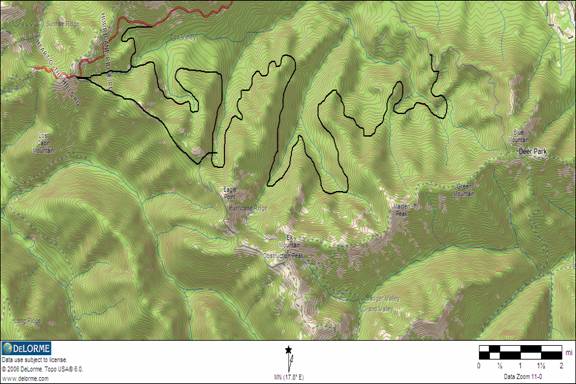
4. Alternative gates could be made more attractive by creating trails from each
of those spots that would wander through the Morse Creek drainage at about the
3500-4000 foot level, possibly connecting to Deer Park Road, creating loops
with the Cox Valley trail, the PJ Lake Trail, and the Obstruction Point Road/
trail. This trail system already exists under the Alternative A : Current Management
and Alternative C : Visitor Opportunities Emphasis in the Wilderness Draft Management
Plan. These trails could be winter only, requiring only signs and some limbing
of trees. Creating trailheads away from the main lodge area would disperse overcrowding
and parking issues that currently exist. Dispersed use increases wilderness
values. Cost: $10,000 for trail scouting and maintenance. Grant and/or volunteer
funded.
5. Train or hire an avalanche expert to produce credible avalanche forecasts
for the Olympics. The NWAC does a good job, but is focused more on the Cascades,
and doesn’t have reliable data for the Olympics. The posted danger at
the park entrance doesn’t always match the NWAC forecast, and doesn’t
provide enough detail. Park staff should actively coordinate avalanche forecasts
with the NWAC. One key to better avalanche forecasting is daily tracking of
snow conditions. Daily access is a key. This is an opportunity for a volunteer
organization such as the Winter Sports Club and/or Olympic Mountain Rescue.
Cost: $2,000 to host avalanche expert to teach Level II and III avalanche courses.
This cost could be defrayed by opening the class to paying members of the public.
6. There should be a relationship between what the NWAC states is the avalanche
danger and road opening and closing. Road closures on scheduled open days do
not seem to be related to avalanche danger. For example, on Friday March 2 there
was an Avalanche Warning posted by the NWAC but the road opened. On Friday March
8, there was a moderate danger posted by the NWAC yet the road was closed due
to “dangerous conditions.” Cost: $0.
7. Do a better job of communicating Hurricane Ridge information via telephone
line and website. Anyone traveling from more than Port Angeles needs more lead
time to make a go/no go decision. Stating a probability the night before would
be nice. If the road crew works all day Thursday, then they should have a pretty
good idea what is going to happen Friday morning, providing more information
about weather and avalanche danger. Cost: $0.
8. When the road closes due to a full parking lot, establish a system such that
when one car exits the park, one car waiting can go up the road. Cost: $0.
9. In conjunction with a Morse Creek winter trail system, open Deer Park road
during the winter, or close it at varying elevations based on snow level and
removal costs. Cost: $0 for variable openings, unknown for plowing.
10. The Sol Duc road should be kept open all winter. Cost: unknown.
The current management policy of opening the Hurricane Ridge road only
on Fridays, Saturdays, and Sundays has several inherent problems:
1. Letting the road sit fallow for four days increases the amount of snow to
be removed, making it more difficult to clear the road on Thursday. The road
rarely opens on Friday mornings during the heart of the winter.
2. Many people do not work on a Monday through Friday schedule. Those people
are effectively eliminated from winter recreation opportunities on the Peninsula.
3. Often the weather is beautiful during the week, but stormy or rainy on the
weekend. Besides denying access on beautiful days, stormy weekends require closure
of the road on scheduled open days, further reducing an already limited schedule.
4. Winter recreation enthusiasts on the greater Peninsula need to KNOW road
status in order to commit to the long drives associated with coming from Forks,
Port Townsend, Silverdale, Bremerton, Bainbridge and Seattle. Even on scheduled
open days, the 8:30 message doesn’t allow people traveling from Silverdale
or Port Townsend time to drive to the ridge and enjoy more than half a day.
Many days the 8:30 message says check back at 10:30. People don’t gamble
on whether the road opens, and instead go to the Cascades, or do something else.
5. Avalanche conditions and snowpack analysis are not reliable.
6. Overcrowding and parking issues are increased because when the road is open
people feel they need to take advantage. One viable access point also contributes
to congestion. Creating winter trailheads away from the main lodge area would
disperse use and create a better wilderness experience.
7. Opportunities are missed for education, recreation, tourism, and visitor
experience.
8. Opportunities for synergy with regional government and volunteer organizations
are missed.
9. The seasonality of the tourism industry on the Olympic Peninsula is exaggerated.
Olympic National Park should be a major winter attraction. Winter access is
one aspect in combination with storm watching, surfing, kayaking, biking, sailing,
and other environmentally sound recreation experiences.
One immediate solution is to partner with the Washington State Parks Winter
Recreation Program. I envision applying for grant funding for two separate projects:
1. Weather permitting Monday road openings. Monday is the easiest day because
the road will already be plowed on Sunday. The specific dates that would be
added are approximately December 3, 10, 17, 2007; January 7, 14, 28, 2008; February
4, 11, 25, 2008; March 3, 10, 17, 24, 31, 2008. As is stated in park literature
April should be excluded from the weekend only schedule. That is 14 more scheduled
dates that the road would be open. The grant request would cover the cost of
a plow truck, driver, fuel, oil and related costs.
2. Morse Creek Winter Trail. This project would apply for funding to develop
and sign an ungroomed trail from the double parking area and the third peak
parking area. This trail should connect to the Obstruction Point Road/Trail
somewhere around the Waterhole.
It is imperative that we act quickly. The deadline for applying for The Washington
State Parks Winter Recreation program grants for next winter is May 1, 2007.
Proposed winter trail at 3500 to 4000 foot level in Morse Creek drainage.
In summary, the Olympic Mountains in winter are an essential element
of the Olympic National Park experience. The future of Port Angeles business
is linked tightly to outdoor recreation and tourism. To live in Port Angeles
is to truly live where the Mountains meet the Sea. Creating a management plan
to allow predictable and consistent year round daily access to the high country
would allow tourists and local residents to better enjoy the wonder that is
Olympic National Park.
The Washington State Parks Winter Recreation Program is an excellent candidate for potential partner. The current strategic plan makes the following statements (Italics are added for areas that I feel synchronize with the goals of ONP, FONP, and other organizations):
1. GOAL: The Winter Recreation Program is respected and trusted by
its volunteer support, and is effective in the coordination and utilization
of volunteers and volunteer organizations.
A. Create formalized
relationships with volunteers and volunteer organizations.
2. GOAL: The Program is guided by a comprehensive, forward-thinking
Strategic Plan that addresses program management and provision of future facilities
and services, and that is useful to other State Parks’ planning applications
(such as Park Plans, the Trails Plan, etc.).
A. Planning and
development of future facilities and services will be responsive to user needs
and concerns, and will address overcrowding and use conflicts.
B. Utilize the Interagency
Committee for Outdoor Recreation (IAC), the Statewide Comprehensive Outdoor
Recreation Plan (SCORP) and input from other governmental organizations
(such as the U.S. Forest Service and counties) in the planning of facilities
and services.
C. Encourage local
stakeholders to cooperate with State Parks to develop area-specific plans that
are consistent with and help implement the Strategic Plan.
D. Planning and
development of future Sno-Parks and trails should consider potential links to
other attractions and amenities, including national, state and local parks,
historic sites, and scenic views.
E. Planning and
development of future Sno-Parks and trails will consider length of season and
reliability of snow cover.
3. GOAL: Sufficient opportunities for recreational access are available
to meet user demand.
A. Actively participate
in land use planning processes carried out by various land management agencies
to advocate for recreational access.
B. Pursue the improvement
of parking and trailhead facilities.
C. Seek to develop
a network of groomed and ungroomed trails that meet the needs of an existing
and future population engaging in winter recreation in Washington.
D. Pursue adequate access
to off-trail recreational activities, such as snowshoeing, climbing, backcountry
camping, sledding and general snow-play.
E. Identify a list
of desirable trailheads that currently do not have winter access, but have future
potential.
F. Establish more sno-parks
and expand trail systems, including non-groomed trail routes into backcountry
areas.
G. Install more
sanitation facilities where needed.
H. Provide equipment
rental opportunities at Sno-Parks.
I. Explore the use
of weekend Nordic bus service to Sno-Park areas to avoid parking problems.
J. Provide plowed
parking access to ungroomed trails and backcountry areas for snowshoers and
cross-country skiers seeking a more pristine experience.
4. GOAL: Safety, education and enforcement are integrated into Program
services.
A. Pursue additional
warming shelters in key locations.
B. Require staff
and volunteers to receive avalanche awareness training.
C. Partner with
other governmental agencies in training of volunteers to do trail maintenance.
5. GOAL: The public is aware of the services provided by the Winter
Recreation Program and the availability of statewide recreational opportunities.
A. Publish and distribute
maps and brochures showing the locations of recreational opportunities (including
groomed and ungroomed trails) and explaining program funding mechanisms.
B. Utilize a variety
of websites and links, including those maintained by State Parks, Outdoor Clubs,
Chambers of Commerce, WSSA, and regular news releases about Winter Recreation
Program functions, activities and projects.
C. Provide consistent
and periodic updated information on trail conditions and status.
6. GOAL: Program funding is sufficient to provide effective service
to the public and distributed in an equitable and effective manner.
A. Examine Sno-Park
permit fees to ensure that revenues are adequately covering access for non-motorized
activities, and to provide for development of new areas.
B. Develop a program
to better utilize available funding from other grant programs.
C. Find and take
advantage of other funding sources.
7. GOAL: The Program recognizes when uses are incompatible, and provides
adequate separation among incompatible recreational uses.
A. Sno-Park areas
should serve dedicated trail systems when possible to meet the needs of a variety
of incompatible uses.
If we can write a good grant proposal in time, it should score high on their criteria. Factors in our favor include: no SnoPark access on the Peninsula; partnerships with ONP, FONP, HRWSC, Clallam County, City of PA, and others; leveraged funding; demonstrated need with closures due to full parking lots; no potential snowmobile conflicts; strong community support; economic justification; long user season; unified land ownership and others.
I was going to save this for a FONP board meeting, but the May 1 deadline doesn’t give enough time. Thank you for your time
Greg Halberg
(360) 928-3341